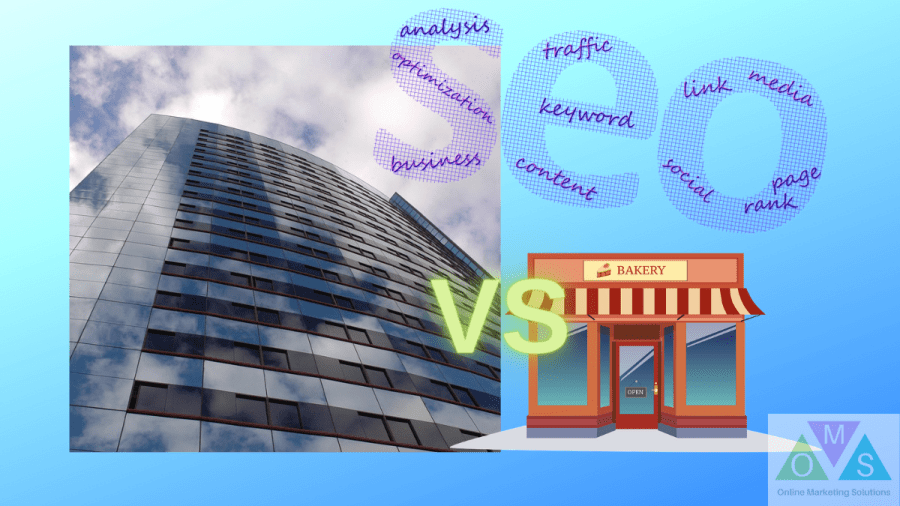
In today’s digitalized world Search Engine Optimization (SEO) is a fundamental part of any marketing strategy, no matter of the size of the business.
However, the size of the business plays a significant role in the creation of an SEO strategy. Not only the final goal will be different for well-established brands and for smaller companies, but also the way of achieving that goal.
Knowing the difference between the enterprise SEO and small business SEO is necessary to create a successful marketing strategy.
What’s the difference between the enterprise SEO and small business SEO?
1. Goal
- Small business
SEO is fundamental for increasing the visibility of a website or a web page to users of a web search engine. Without SEO, they practically don’t exist online. Small businesses need SEO to tell the world about its existence, to find customers and effectively communicate with them.
- Enterprise
SEO is used to grow not so much the quantity, but mostly the quality of website traffic.
Enterprises utilize SEO to increase customers’ trust and loyalty by building a positive customer experience at every stage of the customer journey.
2. Scale
- Small Business
Typically one website with a few pages. The best approach is to use one language and focus on local SEO. Include the main keyword the business wants to be found by on the landing page. Always include the keyword in the title tag, meta description and the page copy. Remaining pages, like blog or portfolio, can use different keywords, same manner, one keyword per page. A contact page is mandatory for the local SEO. Must include all possible contact details and location map.
- Enterprise
The scale is much bigger. Established brands could have several websites, with thousands of pages in several languages. Always use only one language per website, with a country-specific ccTLD (dot-uk, dot-usa, etc.), currency, the opening hours and, of course, the country-specific content. The content will include a wide range of keywords, with competitive head terms.
2. Positioning in search engines
- Small business
The search engine positioning depends on several factors. To beat the competitive websites focus must be placed on the page relevancy, quality and originality. A relevant keyword and must be used wisely, placed in the title tag, meta description and page copy. The content must be well research, good quality (no grammar or spelling errors) and authentic. Important factors are the internal and external links and social media mentions.
- Enterprise
Unique position in Google search and its current capabilities and trajectory. Brand’s need to protect its existing search footprint against fluctuations in Google’s algorithm. It is, therefore, crucial to follow the search engine algorithm updates, avoid search engine penalties for low quality or irrelevant content, or SPAM links, etc. and prevent any technical issues on the websites.
4. Keyword Research
- Small business
Choosing less competitive keywords or niche-specific long-tail keywords. Finding keywords based on the most common questions of the target audience.
- Enterprise
The usage of branded keywords. Searching for keywords including brand name or product. The target audience already knows the brand and is intreated in purchasing the products.
Getting a large number of target keywords, also those which not include the brand name will help to grow the brand. Google will associate the brand with those keywords and make them relevant.
5. High-quality content
- Small business
The content must be relevant to the search, as well as authentic. It is therefore extremely important to well research the target audience and what they are looking for. But also, to find the Unique Selling Points USP’s and the niche for a business. Then create an authentic content highlighting the USP’s. Making it personal and sharing a business story and values helps to stand out and build a stronger relationship with the audience. Always check for any errors and read the content out loud before publishing it.
Read about High Converting Blog Posts to improve the content quality for small businesses.
- Enterprise
Branded content is intended to increase credibility. It must, therefore, demonstrate expertise and value.
E-A-T (Expertise, Authority and Trustworthiness) serves as good practice for brands. This further supports the ongoing push by Google for content quality. The following considerations apply here: Is the author a topic expert? Does the author have some known authority on the topic or in their industry? Does the content appear trustworthy? (Condron)
Content published on high quality, secured, fast loading and well-designed website is a must for Enterprise SEO.
6. Measuring Success
Both small businesses and enterprises can measure the same metrics for the effectiveness of the SEO strategy. Small business with a restricted budget and the workforce will highly likely use a free and straightforward tools. Whereas enterprises can outsource the measurements and data analysis to a specialist, as well as use the paid tools providing more data. Also enterprises measure customer satisfaction at every stage of the customer journey, therefore more data is a need. Small business doesn’t need to go so deep into details.
Important SEO metrics to measure are:
◦ Organic traffic.
◦ Organic bounce rate.
◦ Organic conversion rate.
◦ Top exit pages for organic traffic.
◦ Breakdown of organic traffic from Bing and Google.
◦ Keywords ranked in Google.
◦ Local visibility.
◦ Click-through rate (CTR)
◦ Indexed and Crawled pages, as well as indexing and crawling errors. Read more in Search Engine Land
Website performance measuring tools:
Google Keyword Planner, Google Analytics, Google Search Console, DeepCrawl, ScreamingFrog, Ahrefs, Moz or Woorank.
Specialized SEO tools:
◦ Google PageSpeed Insights and Pingdom measure page load times.
◦ Google’s Structured Data tool helps you to construct a rich schema.
◦ Google’s Mobile-Friendly Test tool improves mobile optimization.
◦ W3C Validator automates code validation.
Summarising
An enterprise SEO and a small business SEO have some major differences. Not only a final goal varies, but also a scale, positioning, and a type of content. Various measuring tools can be used for both, but enterprises need far more data comparing to the small business.
The differences between enterprise and small business SEO are important to know for the marketers, and the business owners to create a successful digital marketing strategy.
To learn more about engaging and connecting with the customer read Digital Branding and Brand Engagement – Customer Behaviour and Digital Branding and Brand Engagement – Content Marketing.
To learn more about the digital brand expansion make sure to read: Digital Branding and Brand Engagement – Owned Media Marketing, Social Media Marketing Strategy For Businesses. Expand Your Online Reach and How the Search Engines can help your business? SEO Plan and successful SEM campaigns.
Thank you for Reading!
Ola van Zyl
Did you enjoy reading this post? Feel free to like and share.
Thank you!
 Online Marketing Solutions