The brand engagement of today’s customer is increasing. The customer can engage with the brand in many ways, influencing the brand marketing strategies. This presents a huge opportunity for marketers, who can now interact with customers across multiple touchpoints. As well as a challenge to get to know the customer and try to meet their significantly growing expectations.
Digital Marketing Landscape – POEM
Today’s marketing landscape is very dynamic which creates many opportunities and challenges for the marketers. There are currently different media frameworks used within the industry Paid Owned Earned Media (P.O.E.M). POEM incorporates traditional marketing, digital media and engagement as a more holistic, integrated marketing strategy.
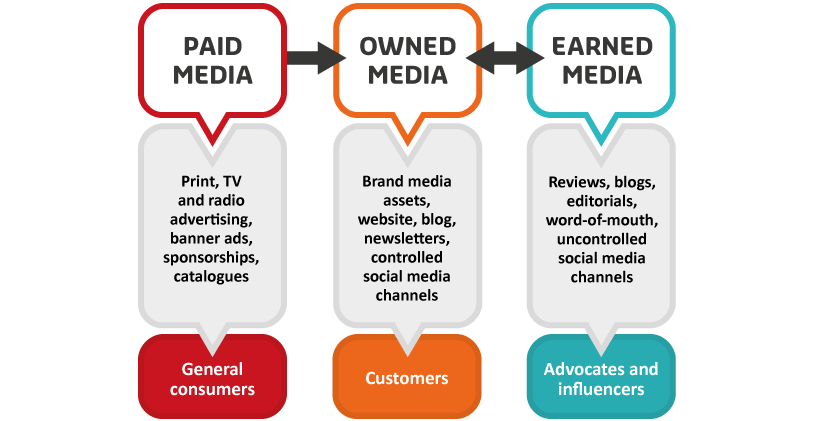
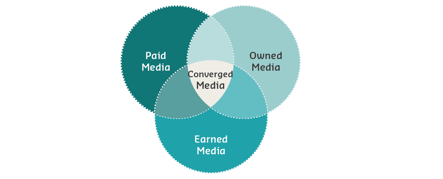
The dividing lines between those are gradually fading. Marketers are combining all types of media for the best results of their campaigns.
This is called the Media Convergence
Media Convergence is the merging of previously distinct media technologies and platforms through digitization and computer platforms.
Gasher, 2019
Digital customer behaviour
Customer power has shifted. The audience is no longer passive. The technology allows the customer for better communication with the businesses. According to 2018 US Adobe study customers now spending 25% of the day on engaging with digital content. They can now leave a comment and opinion, ask questions, like, share, dislike, etc.
Customers engagement trends for 2020
- The rise of self-service and self-help.
- Transparency in customer service.
- Balancing out humanity and automation.
- Hyper-personalized experiences.
- Data privacy and cybersecurity.
- Employee experience influenced CX.
- Soft skills are the new hard skills.
- Location-Based Mobile Interactions.
- Permeable Gamification.
- Influencer Networks and Natural Connections.
- Branded App Development and In-App Placements.
- Social Selling.
Read more about the customers engagement trends at Maysbyn and Gminder
As customer behaviour is changing and the expectations are growing higher it leaves the businesses with lots of questions. Where to invest in the marketing budget? How to create engaging and interesting content for the customers?
Today’s audience has the power to skip or entirely block the ads, and they do so commonly. Paid search, where half of the marketing budget is often invested (MAGNA), has a considerably lower click-through rate than the organic search. This is a problem for marketers who have to rethink their message to the customers, to regain power over them.
There are a few solutions here. To create more engaging ads that the customer wants to click to watch it. To focus more on the marketing efforts on the organic search. Or, to embrace the enhanced customer power and let the customer engage with the brand.
Harnessing the power of the customer
Many brands are taking advantage of the customers’ power and are harnessing it through,
- Getting the customer involved in the creation of new products.
- Engaging the customer in content development and social media.
Consumer empowerment will continue to grow through not only the improvement in smartphone technology, but also new technologies including IoT, and wearable technologies.
Consumer demand will increasingly be met through a mobile or home hub experience, such as Amazon Echo or Google Home – which will become more integral in consumers’ purchases of good and services.
Smartphone usage will help the empowered consumer through increased functionality such as faster processing power, AI apps, more transactional capabilities and the emergence of augmented reality.
The Deloitte Consumer Review, 2018
Only by understanding the customer behaviour to create a personalised and interesting content that is meaningful to them can the marketer communicate successfully with the audience.
Tweet
Participation branding and brand engagement
Participation Brands
The most potent and efficient brands in the world today are being built with people, not for them.
The Iris Participation Brand Index study
Today’s customers have considerably more power over brands than they use to have. Attractive and engaging content, as well as conversation with the audience, becomes increasingly important.
To be able to communicate well with the customer the brands must embrace the power of the customer. Such brands are called the Participation Brands.
Participation Brands
- Have a passionate purpose.
- Are culture-shaping – leading cultural shifts.
- Are category innovating.
- People-powered.
- Have a distinctive character.
The growth of social media and search engines have created an opportunity for all size of businesses to become participating brands. Even small businesses, with less budget, can now be more responsive to the market and technology.
People-powered branded communities are an example of one of the key approaches to participation branding.
Branded communities can bring benefits such as reduced costs, brand exposure, customer retention and importantly real customer insight to inform decision-making.
Brennan, 2019
Brand Advocacy
The increased influence of customers over the brands creates brand advocacy. A brand advocate can endorse a brand or product via social media or company website. They can articulate their opinion by leaving a comment or testimonial on the pages of the business or sharing it through their own social media profiles. Even a negative review can become an opportunity if handled in appropriate manner.
Brand advocacy is a great way for the brands to get recommended to a wider audience with no cost at all. The brands can also choose to use social media influencers with a significant amount of followers to promote themselves. For this kind of promotion, the brands will usually need to pay.
Brand advocacy can have a huge impact on businesses. The online reviews influence the purchase decisions for 93% of consumers.
Tweet
The online review statistics show that,
- 97% of people read reviews for local businesses. (BIA/Kelsey)
- 91% of 18-34-year-olds trust online reviews as much as personal recommendations. (BrightLocal)
- 89% of consumers read businesses’ responses to reviews. (BrightLocal)
- 68% of consumers will leave a review if asked. (BrightLocal)
A great example of participation brand extensively using brand advocacy to promote their business is fashion designing MOSCHINO. Moschino has successfully created a branded community including artists, models, fitness personalities and other influencers, who promote the brand over social media.
Behavioural segmentation
The digital customer behaviour can vary depending on the person. One might strongly associate with the brand but refuse to become a brand advocate for some reasons, etc. It is not easy for the brands to communicate and build a relationship with a customer.
The audience multiplicity is a definite challenge. Behaviour segmentation, based on for example demographic groups and their online interactions can become handy here.
Based on the Global Web Index survey, we can categorise the audience based on behavioural segments, as follow:
Commenters – Say that sharing their opinion is a very important reason for using the internet, or have asked a question to a brand on a social network or micro-blog in the last month, or have posted a comment in a forum in the last month.
Creators – Have uploaded/shared a photo online in the last month, or have uploaded/shared a video online in the last month, or have uploaded a photo or video to a brand’s social network or microblog page in the last month, or have provided ideas for a new product/service or a new brand design in the last month.
Followers – Follow brands they like on social media, or follow brands they are thinking of buying something from on social media, or have liked or followed a brand on a social network or micro-blog in the last month, or have visited a brand’s social network page or micro-blog page in the last month.
Listeners– Have listened to an online radio station/service in the last month, or have listened to or watched a podcast in the last month, or have used a music- streaming service in the last month.
Reviewers – Have left feedback or a review on a brand’s website in the last month, or have posted a review of a product, company or service online in the last month.
Sharers – Say that sharing content is a very important reason for using the internet, or have used a “social share” button on a website to share something with their social network contacts in the last month, or have shared a brand’s post on a social network or micro-blog in the last month.
Shoppers – Say that researching/ finding products to buy is a very important reason for using the internet, or have purchased a product online in the last month, or have searched online for a product or service they want to buy in the last month, or have used a price comparison service in the last month, or have visited an online auction site in the last month, or have visited an online retail site or store such as Amazon / Taobao in the last month.
Viewers – Say that entertainment (e.g. gaming, films) is a very important reason for using the internet, or have used a streaming service to watch live television in the last month, or have used an on-demand / catch-up TV service in the last month, or have used an online TV/film subscription service in the last month, or have watched a vlog (a video of a blogger) in the last month.
Workers – Say that researching for work, networking for work or sharing their business expertise are very important reasons for using the internet.
Unengaged – Fall into none of the segmentations outlined above.
Only by understanding the digital behaviour of the target audience, the marketer can effectively communicate with the customer.
Tweet
Summarising, the technological change is continuously driving the customers’ empowerment, allowing them for increased brand engagement. Therefore, building branding communities and brand advocacy become essential for the brands. To better communicate with the audience the businesses should segment their target market.
To learn more about the digital brand expansion make sure to read: Social Media Marketing Strategy For Businesses. Expand Your Online Reach and How the Search Engines can help your business? SEO Plan and successful SEM campaigns.
Thank you for Reading!
Ola van Zyl
Did you enjoy reading this post? Feel free to like, share and comment. Thank you!
 Online Marketing Solutions
Pingback: Digital Branding and Brand Engagement – Content Marketing – Online Marketing Solutions
Pingback: Digital Branding and Brand Engagement – Owned Media Marketing – Online Marketing Solutions
Pingback: Mobile Marketing Strategy for Business – Online Marketing Solutions
Pingback: Marketing Strategy to Build a Premium Brand. – Online Marketing Solutions
Pingback: 6 Major SEO Strategy Differences between Enterprise and Small Business. – Online Marketing Solutions
Pingback: How Google Display Ads Can Help to Grow Your Business. – Online Marketing Solutions